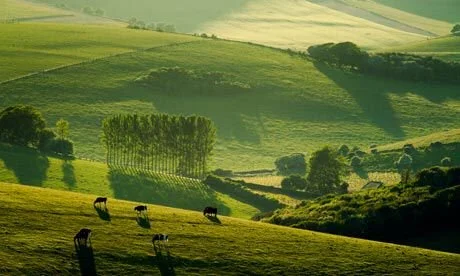
Sussex Landscape Medicine — How Place Shapes the Body and the Nervous System
There are landscapes that change you the moment you step into them.
Sussex is one of them.
The South Downs rise in slow, generous curves, holding a horizon that seems to stretch into some ancient memory the body recognises long before the mind does. The wind moves differently here — not in sudden bursts, but in long, sweeping currents that clear the head and widen the breath. Even the light is distinct: chalk-reflected, soft-edged, diffuse. When people move through this landscape, something inside them shifts, even if they can’t name it.
This is landscape medicine.
Every region has a medicinal signature, and Sussex’s is one of clarity, spaciousness, gentle unraveling and emotional exhale. It is not a place that demands; it invites. There is a steadiness to the Downs, a rhythm that helps the nervous system step out of vigilance and into something more expansive.
When I began working on the Sussex coast, I realised very quickly that the land itself was a co-practitioner. It worked alongside the herbs, amplifying their effects in ways I had only ever sensed in fragments before. Clients who had been stuck in freeze states began to feel movement again. People who carried long-held contraction found small pockets of softening. Those who had been living in chronic overwhelm experienced the first moments of internal quiet they’d felt in years.
It wasn’t me.
It was the land.
And as I listened more closely, I began to understand that the Sussex landscape carries a very specific kind of medicine — one that supports the emotional and physiological repair so many people are now seeking.
1. The Chalk — A Medicine of Lightness and Breath
The chalk of the South Downs creates a unique sensory field. Chalk doesn’t trap heaviness; it reflects light. It holds the memory of ancient seabeds, fossilised creatures, long cycles of rise and return. There is something about walking on chalk that lifts the internal weight people carry.
Clients often describe it as “feeling like I can breathe again.”
This is chalk medicine.
Chalk teaches the body how to release what is heavy, stagnant or held too tightly. It encourages upward movement — clarity, perspective, widening. It’s no coincidence that people with chronic rumination or emotional constriction often find relief simply by walking up onto the open ridges.
2. The Wind — A Nervous System Reset
The Sussex winds, especially along the coast and higher paths, are not harsh; they are cleansing. Wind is movement. It disrupts stagnation. It clears the mind as surely as any aromatic herb. It interrupts spirals of overthinking. It shakes loose the emotional residues that cling when life has become too static or too small.
Many times, I have watched clients arrive with tight shoulders, shallow breath and agitation — and return from a short walk with loosened eyes and softer muscles.
Wind is nature’s mover.
A living, breathing analogue to the aromatic herbs I use in formulations.
3. The Hedgerows — Containment, Boundaries, Holding
Sussex is defined by its hedgerows — dense, ancient, layered with hawthorn (Crataegus monogyna), blackthorn, rose, elder and honeysuckle. Hedgerows are boundary medicine. They represent containment without confinement, separation without isolation.
People who struggle with boundaries, who give too much, feel too much, or hold emotional weight that isn’t theirs, often respond deeply to hedgerow walks. The nervous system learns through metaphor and through place. The hedgerow becomes a teaching.
This is why hawthorn — the heart-keeper of Sussex — is one of the most important herbs in this region’s landscape medicine. It strengthens the emotional core, protects the heart, steadies overwhelm and helps people differentiate their own energy from the demands around them.
4. The Juniper — Clarity, Direction, Inner Fire
Juniper (Juniperus communis) grows in small, scattered colonies on the Downs. It is a teacher of boundaries, direction and inner clarity. Juniper thrives in harsh conditions, clinging to slopes and thriving where other plants cannot. Its medicine is one of purification and focus.
In the emotional terrain, juniper helps restore the inner compass — the sense of knowing what is yours and what is not, what matters and what never did.
This plant is a guardian of coherence.
5. The Coast — Softening and Surrender
Where the Downs meet the sea, there is another kind of medicine entirely — a spaciousness that dissolves internal armour. Water speaks to the emotional body. It softens hardness, washes overwhelm, and invites people back into a sense of flow.
For clients who are holding grief, fear, exhaustion or emotional collapse, the coastline becomes part of the therapeutic field. The constant movement of the water helps the mind relinquish its grip and the body relinquish its vigilance.
The coast teaches us how to release what was never meant to be carried alone.
Landscape as Practitioner
This is why Sussex Herbal exists here, and not somewhere else. Because the land shapes the medicine. The Downs teach. The plants teach. The wind teaches. And the body responds to this teaching in ways that no formula alone could create.
When I work with someone — whether through consultations, iridology, the Deep Reset or the Longevity Year — the Sussex landscape becomes part of the process. It isn’t simply a backdrop; it’s a co-facilitator. A quiet companion in the journey back to coherence.
Healing is not only about herbs.
It’s about place.
Belonging.
Pattern.
Breath.
Reconnection.
Nature as mirror.
And Sussex, with its gentle clarity and spacious medicine, is one of the most powerful mirrors I know.
Slow Medicine — Why Healing Takes Time
One of the first things I tell clients — often before they’ve even sat down — is this: Your body is not late, behind, failing or broken.
It is simply trying to heal at the pace that life has allowed.
We live in a culture that treats the body as an inconvenience, an obstacle to productivity, a machine to be optimised and forced into compliance. When symptoms arise, we’re taught to silence them quickly, to override them, to carry on. But the body is not a machine. It is a living ecosystem — responsive, relational, intelligent, and deeply shaped by time.
Healing is not a quick fix.
Healing is a conversation.
And conversations take time.
I call this slow medicine: a way of supporting the body that honours its rhythms, respects its pace, and understands that deep repair unfolds seasonally — not on command.
Why Quick Fixes Don’t Work
Most symptoms are not sudden.
They are the end result of years — sometimes decades — of:
chronic stress
emotional suppression
overextension
poor boundaries
nervous system depletion
ancestral patterning
digestive compromise
exhaustion
grief
trauma
rushing
holding everything together
ignoring early whispers
When someone comes to me with burnout, anxiety, inflammatory flare-ups, digestive unraveling, hormonal collapse or emotional overwhelm, the first thing I recognise is not their pathology — it’s their history.
Healing can’t be rushed because the body remembers.
And the body will only let go of what it feels safe to release.
Why Herbs Need Time
Herbs do not work like pharmaceuticals. They don’t suppress symptoms; they shift terrain. They strengthen what is weak, soften what is tight, uplift what is heavy, cool what is inflamed, and nourish what has been chronically depleted. But they will not do this overnight — nor should they.
When herbs are given time:
digestion recalibrates
inflammation reduces
the nervous system steadies
hormones rebalance
the emotional terrain becomes clearer
the mind becomes less reactive
the breath deepens
coherence emerges
This is why I use a six-week rhythm in The Turton Method™.
Six weeks gives enough time for the body to respond without pushing it beyond its capacity.
A six-week cycle mirrors nature: unseen roots strengthening below the soil, slow growth, gentle unfurling — not the frantic pace of forced change.
Nature’s Timing
If you look closely at the natural world, you’ll see the truth of slow medicine everywhere.
A hawthorn tree does not rush its blossom.
Chamomile does not bloom before the soil warms.
Juniper berries take two full years to ripen.
Meadowsweet returns only when the light is right.
Seasons do not accelerate themselves for convenience.
Everything in nature moves in a rhythm that honours life, not productivity.
And because our bodies are part of nature, not separate from it, we respond best when we adopt the same rhythm.
When clients work with me — whether in consultations, The Deep Reset, or the Longevity Year — the first real shift often isn’t physical. It’s pace. They slow down enough to notice themselves. To listen. To repair. To breathe. To feel.
And suddenly, healing becomes possible.
The Nervous System Needs Time
Nervous system healing is some of the slowest work there is.
A system that has been bracing for twenty years cannot unclench in two sessions.
A system that has lived in survival-mode will not relax because we tell it to.
A system that has collapsed from overwhelm needs nourishment before activation.
Time is the medicine.
Safety is the container.
Presence is the catalyst.
This is why deep work requires holding — the kind of holding that is consistent, grounded and gentle. Not the pressure of weekly sessions or the sporadic nature of one-offs, but the steady, predictable rhythm of six-week cycles.
Healing is not about forcing the body into change; it’s about giving the nervous system the conditions that allow it to choose change.
The Emotional Terrain Unfurls Slowly
When someone finally feels safe enough to soften, old patterns rise to the surface — not to cause trouble, but to be released.
Over time, I’ve seen:
grief that was held for decades begin to thaw
anger transform into clarity
fear dissolve into steadiness
exhaustion shift into grounded energy
shame give way to self-recognition
None of this happens quickly.
And none of it happens on someone else’s timetable.
The emotional body has its own seasons.
The Gift of Slow Medicine
If you allow the body the time it needs, something unexpected happens:
healing stops being a project and becomes a relationship.
You begin to trust your body.
You stop reacting to every symptom with panic.
You stop fighting yourself.
You start listening.
You start noticing what feels nourishing and what feels draining.
You begin to move with the grain of your life, not against it.
Slow medicine teaches that healing is not a destination.
It is a change in how we relate to ourselves.
It is an exhale.
A re-rooting.
An inner shift in direction.
A return to coherence.
A remembering of rhythm.
And when someone reaches that moment — that gentle, unmistakable sense of coming home to themselves — that is when true healing begins.
How Herbs Support the Nervous System
If there is one thread that runs through almost every client I see — whether they come with digestive discomfort, hormonal changes, chronic inflammation, burnout or emotional collapse — it is this:
Their nervous system is tired.
Not simply “stressed,” which implies a temporary state, but tired in the deeper, older, more systemic sense of the word.
Tired from years of bracing.
Tired from carrying too much.
Tired from overriding discomfort.
Tired from caring for others before themselves.
Tired from surviving.
Tired from holding tenderness in a world that rarely honours it.
And because the nervous system is the energetic spine of the whole body — influencing digestion, hormones, immunity, inflammation, emotional regulation, sleep, breath and boundaries — any meaningful healing must include it.
This is where herbs become profound partners.
Not because they sedate or numb, but because they meet the nervous system where it is, inviting it to soften, strengthen and re-pattern gently from the inside.
Three Nervous System Truths
Over time, I’ve learned three truths that shape the way I work:
1. A tense system cannot digest.
Constipation, reflux, bloating, cravings, diarrhoea, erratic appetite — these are often nervous system symptoms as much as digestive ones.
2. An overwhelmed system cannot regulate.
Hormones destabilise. Sleep fragments. The immune system misfires. Inflammation spikes.
3. A depleted system cannot repair.
The body needs deep safety to heal. Herbs help create that internal space.
In The Turton Method™, this is always the first question:
What does the nervous system need to feel safe enough to change?
Herbs become the bridge.
Linden — The Softening
Linden (Tilia cordata) is one of the most beautiful herbs for the nervous system. It doesn’t sedate; it softens. It brings the breath back into the body. It soothes the emotional heart, loosens tension in the chest, and calms the spiralling mind.
Linden is the herb I turn to when someone is caught between overwhelm and collapse — when they need tenderness, not strength.
It reminds the body how to exhale.
Chamomile — The Unwinding
Chamomile (Matricaria chamomilla) is one of the most misunderstood herbs. People think of it as mild, but chamomile is powerful medicine when used with intention.
It works on the gut-brain axis, relaxing tension in the digestive tract and calming emotional agitation at the same time.
Chamomile unwinds the places where emotion knots into the body — the clenched solar plexus, the held diaphragm, the tight jaw.
It is the herb of gentle unravelling.
Oatstraw — The Rebuilder
Oatstraw (Avena sativa) is nourishment in plant form.
Where linden softens and chamomile unwinds, oatstraw rebuilds. It restores the depleted, the exhausted, the frayed edges of a nervous system that has been running on fumes for too long.
Oats don’t force anything.
They feed the system.
They fill the wells.
This is the herb for people who have been carrying emotional labour, cognitive load, responsibility, caregiving, and constant vigilance.
It doesn’t ask for change; it offers strength.
Rose — The Tenderiser
Rose (Rosa damascena) works on the emotional terrain as much as the nervous system. It protects softness, heals old wounds, and brings a sense of dignity back into those who feel worn down by life.
Rose is the medicine of self-compassion — a quality that is essential for nervous system repair.
When I include rose in a formula, it is often because the emotional body needs as much holding as the physical body.
Juniper — The Clarifier
Although not traditionally classed as a nervine, juniper (Juniperus communis) has a profound effect on the emotional and energetic nervous system.
Juniper brings clarity, direction and inner boundaries.
It helps people recognise what is theirs to carry — and what is not.
For those whose nervous system is overwhelmed by emotional entanglement, people-pleasing or porous boundaries, juniper is a steadying ally.
It gives back the inner compass.
Herbs Don’t Just Calm — They Repattern
The biggest misconception about herbs for the nervous system is that they simply calm or relax. But true herbal nervous system support is far deeper. Herbs help:
interrupt old stress loops
strengthen the parasympathetic response
support vagus tone
reduce inflammation
nourish depleted tissues
create a sense of internal safety
restore emotional resilience
rebuild the capacity for rest
Herbs don’t override.
They don’t force.
They invite the nervous system back into coherence.
And when combined with the six-week rhythm, emotional terrain work and simple lifestyle changes in The Turton Method™, that invitation becomes powerful.
The Sussex Nervous System
Here in Sussex, the nervous system medicine is amplified by place. The wind, the chalk, the hedgerows, the sea — all of them work like a living nervous system tonic.
This is why people feel better before I’ve even given them herbs.
The land itself co-regulates.
Herbs then deepen that effect.
Together, they create a field of safety — internal and external — within which the nervous system can finally soften.
The Nervous System Knows
The nervous system knows when it is safe.
It knows when it is seen.
It knows when the pace is right.
It knows when the support is gentle enough to receive.
It knows when the burden is shared.
It knows when the body is finally allowed to exhale.
Herbs remind it.
Nature supports it.
And slowly, steadily, the system begins to heal.